


In July 2025, Meta quietly rolled out an AI retrieval engine called Andromeda. Most marketers haven't heard the name. The brands that have heard it mostly filed it under "another platform update" and moved on.
That's a mistake. Andromeda is the single biggest change to how paid social actually works in the last five years, and it has direct, immediate, dollar-level implications for how you should be producing creative right now.
Here's the short version: Meta's system used to ask "who should see this ad?" It now asks "which ad is right for this person?" The job of finding the customer has moved from the targeting layer to the creative layer. Your creative is your target now.
Most brands have not adjusted. They're still producing ads the way they did in 2022, which is a handful of "concepts" the team agreed on in a meeting and three minor visual variants of each, sent to production, and run for a month. That approach is now actively penalized by the algorithm. Andromeda learns from variety, not repetition. If you feed it the same idea five different ways, it has nothing to optimize against. If you feed it five genuinely different ideas, it figures out which one matches which customer and routes accordingly.
This is why we've rebuilt how we run paid creative around a single principle: produce signal, not assets.
The problem with how most brands test creative
Most brands treat creative like an art project. The team gets together, debates concepts, picks two or three "winners" based on what looks best in the deck, sends them to production, runs them for a month, and tries to read tea leaves from the results.
Three things go wrong with this approach.
First, the sample is way too small. You can't learn anything meaningful from three ads. You're not testing because you're just guessing and then watching what happens.
Second, the variation is in the wrong place. Most teams vary the visual with different photos, different layouts, and the same message. But the visual isn't usually what's driving performance. The message is. The persona is. The angle is. The promise is. If you don't vary those, you're not actually testing anything, and you're not giving Andromeda the diverse signals it needs to route intelligently.
Third, the bias toward production quality kills the learning loop. By the time you've spent two weeks shooting UGC for a concept, you're emotionally invested. You're not going to kill it after a week of bad data. You'll keep optimizing around it, hoping it turns. The cost of production has become the enemy of the truth.
Static images are the fastest, cheapest way to feed the algorithm
This is why we start almost every paid sprint with static image testing and not with video, not with UGC, and not with anything that takes a week of production.
A static image takes 15 minutes to produce. We can ship 30 of them in a day. That means we can run a real test: 5 personas × 3 pain points × 2 offers × 2 hooks, all of it live on Meta inside of 48 hours, all of it spent against actual customers in real auctions.
That's not creative volume for the sake of volume. That's structured creative diversification, and there's a big difference.
Random creative volume creates noise. You learn nothing because you have no framework for understanding why something worked. Structured variation creates learnings. Every ad is a controlled mutation of a variable you actually care about, so when one wins, you know what won and why. And just as importantly, you've given Andromeda a rich set of distinct creative signals to match against different segments of your audience.
The persona matrix
Here's what the structure actually looks like. We build a grid before we build any ads:
Take a supplement brand selling to runners. "Runners" sounds like one audience. It's not. It's at least four, and they buy for completely different reasons:
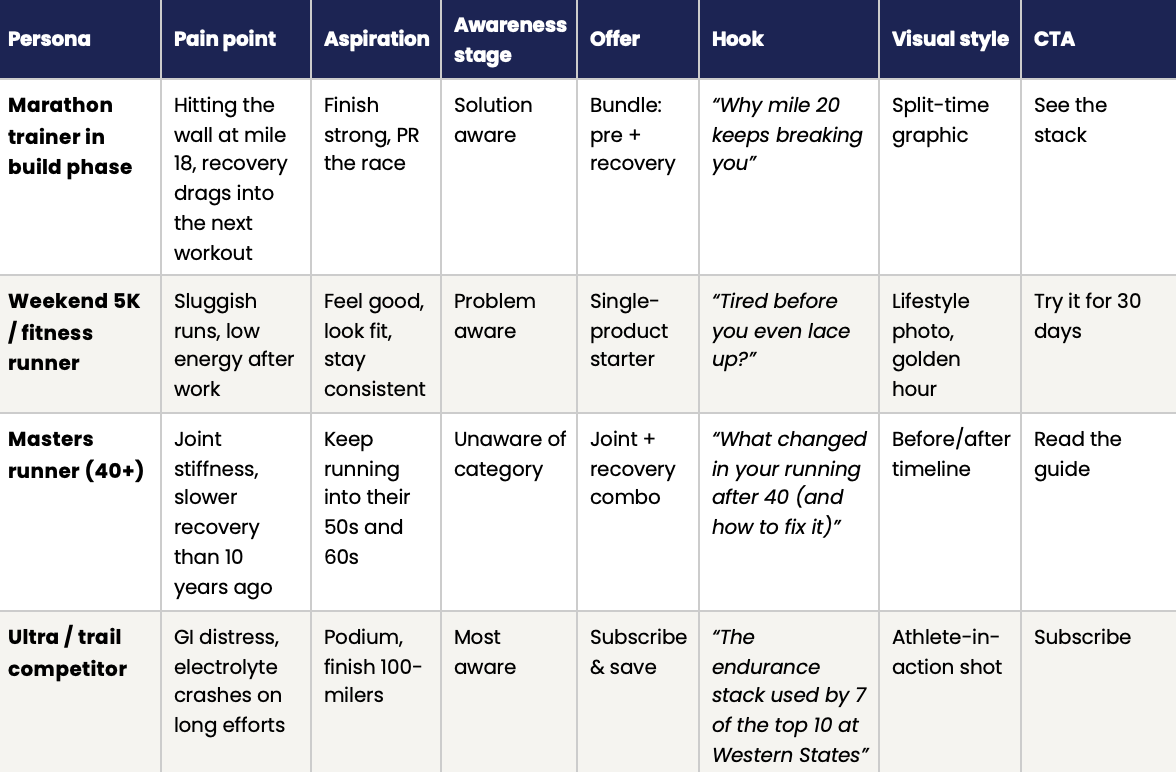
Four personas. Same product category. Completely different pains, aspirations, awareness stages, and reasons to buy. The marathon trainer cares about recovery between hard sessions. The weekend runner just wants to not feel like garbage on a Tuesday evening run. The masters runner is fighting time. The ultra-athlete is optimizing for podium finishes.
If you ran a single generic "fuel your run" ad against all four, you'd get mediocre performance across the board and have no idea why. Run the matrix, and you find out that, for example, the masters segment is where the real margin lives; the marathon trainer converts on bundles, but not single SKUs, and the ultra-athlete only responds to social proof from named athletes. That's four separate scaling paths the algorithm would never have surfaced if you'd only given it one creative to work with.
That's twelve ads minimum before you even start cross-testing variables, and if any one column produces a clear winner, you've learned something the brainstorm could never have told you.
The matrix isn't the output. It's the testing apparatus. We're not picking favorites. We're spreading bets across the entire surface area of the customer base so the market and the algorithm can tell us where the demand is.
Why this is the way to work with Andromeda, not around it
The old playbook was audience targeting. Build the right audience and show them the same ad. That world ended when iOS 14 broke the signal pipe and Meta started building automation tools to fill the gap. Andromeda is the most mature version of those tools.
The practical implication for advertisers is that specificity is rewarded, but only if the specificity lives in the creative itself. If you give Andromeda a single generic ad, it has nowhere to route different audience segments, and every customer sees the same thing. If you give it 15 highly specific ads across personas, pain points, and offers, it figures out who responds to what and routes accordingly. Meta's own guidance is explicit: distinct creative concepts beat minor variations of the same idea, and simplified campaign structures with diverse creative outperform fragmented ones with narrow segments.
That is exactly what the persona matrix produces. It's not a clever workaround. It's the input format the algorithm was built to consume.
The other piece advertisers underemphasize is the data foundation. Andromeda is only as smart as the signals you send it. Conversions API, server-side tracking, and clean event mapping—without those, the algorithm is making decisions on partial information, and even great creative will underperform. The matrix and the data infrastructure work together. One without the other leaves money on the table.
What happens to the winners
Static testing is not the end state. It's the cheapest possible signal collection mechanism, which means it's where you start. Once we have winners, they graduate:
Winning messages become UGC scripts — now we know what to have a creator say on camera, because the market already told us it works in static form.
Winning hooks become landing page headlines — the line that earned the click can earn the conversion too.
Winning personas become segmentation logic — the customers we now know are highest-LTV get their own funnels, their own email sequences, their own retargeting paths.
Winning offers become scale campaigns — once we know which promise resonates, we put real budget behind it.
This is the part most brands skip. They run a test, find a winner, and then keep running the same static ad forever. The whole point is to let the test inform the production. Static is for learning. Video and UGC and advertorials are for scaling.
The mindset shift
If there's one thing to take away from this, it's this:
Most brands try to predict winning creative. We try to evolve it.
Prediction is a brainstorm room, a moodboard, a debate about which concept feels strongest. Evolution is a system: produce many variations cheaply, let the market and the algorithm select, scale the winners, repeat. The system finds answers nobody on the team would have predicted.
The goal isn't to make perfect ads. The goal is to build a system that finds them predictably — and to feed that system the kind of diverse, specific, signal-rich inputs that Andromeda was built to reward.
Most brands waste months debating creative concepts in conference rooms. The market would have told them the answer in 72 hours.
H Street is a growth and demand generation agency built for outdoor DTC brands. If you want us to run a creative matrix sprint against your account — diagnose what's working, what's not, and where the untested angles are — reply to this email and we'll set up a call.
